Dhamma · Reflection · Statements · Peaceful Communication
Archive and publication page · Use Search, Topics, or the Month & Year archive to locate related materials.

Office Of Siridantamahapalaka: July 2025

Chronological Archive

Reclining Buddha at Kushinagar


In 1862 CE (B.E. 2405), Alexander Cunningham, a British archaeologist, came to survey the ancient city of Kusinara (also known as Kushinagar in Sanskrit), the place where the Buddha attained Parinibbāna (Final Nirvana). He discovered many ancient artifacts, including the ruins of stupas and monasteries, which were later restored to their present condition. However, Cunningham did not find any Reclining Buddha statue or a large Buddha image in the Māra-vijaya (Victory over Māra) posture.

It wasn’t until 1871 CE (B.E. 2414) that Archibald Campbell Carlyle, Cunningham’s assistant and a photographer (photography was becoming more common in Europe at the time but was still largely unknown in India), conducted another survey. He excavated around the Parinibbāna Temple area and discovered the Reclining Buddha statue, which was found in a broken state—buried under heaps of bricks and mortar, and fractured into four pieces. Carlyle undertook its restoration.

On the back of the statue was an inscription in Sanskrit using the Brāhmī script, dating to between 600–800 BE (43–257 CE). The inscription reads:


Line 1: Teyadharmo yaṃ Mahāvihāra svāmino Haripalasya
Line 2: Pratimā ceyaṃ kṛtita dina ... māsavarena

Translation:
“This sacred offering is the making of this Buddha image, belonging to the teacher Haribala, who was the head of the Mahāvihāra (Great Monastery). The image was created by a craftsman named Dinna.”

This inscription is extremely significant. Unfortunately, it can no longer be seen today because it has been covered during the statue’s restoration. Luckily, a copy of the inscription was transcribed and preserved by Sir Alexander Cunningham. From this, we learn that the sponsor of the statue was Ācārya Haribala, who is referred to in Sanskrit as Vihārasvāmin, meaning "master of the monastery," equivalent to the modern-day abbot.


The art style of the statue is from the Mathurā school, and based on this, scholars estimate that the statue was created between 600–800 BE (43–257 CE.

Paṭivedha (penetration, realization, understanding)

 "When we say we're listening to Dhamma, practicing Dhamma, studying Dhamma, it needs to align with the Dhamma present in our own aggregates and our understanding.


The existing Dhamma refers to the five aggregates that arise when sense objects meet sense doors.
Sense objects are: visible forms, sounds, smells, tastes, touches, and mental objects.
Sense doors are: eye-sensitivity, ear-sensitivity, nose-sensitivity, tongue-sensitivity, body-sensitivity, and mind-sensitivity.

In simple terms, whenever two physical elements meet, doesn't relevant consciousness arise?
When eye-sensitivity meets visible form, doesn't seeing-consciousness arise? Is it 'I' who sees, or is it just seeing-consciousness? Can seeing occur with consciousness alone?

Don't feeling (vedanā), perception (saññā), and volition (cetanā) arise together with it?
Is it a person, deity, or brahma who experiences the form, or is it just feeling?
Is it a person, deity, or brahma who perceives the form, or is it just perception?
Is it a self that prompts the experiencing and perceiving, or is it just volition?

When feeling, perception, and volition combine, don't we get the four mental aggregates?
These four must be complete for seeing-consciousness to arise. Are these four mental aggregates a person, deity, or brahma?
Is eye-sensitivity a person?
Is visible form a person?
When we analyze, don't we get physical aggregate (rūpakkhandha)?
Combined with four mental aggregates, we get (five aggregates, Venerable Sir). This appears at the eye.

This is why we listen to Dhamma - to understand these aggregates.
We meditate to understand aggregates.
We walk meditation to understand aggregates.
We stand to understand aggregates.
We lie down to understand aggregates.
Isn't this worth examining?

Is sitting meditation primary, or understanding aggregates?
Is walking meditation primary, or understanding aggregates?
Is standing primary, or understanding aggregates?
Is lying down primary, or understanding aggregates?

When we say 'let's meditate,' why don't we say 'let's sit as a person'? Isn't it because there is no person? Worth considering?

When sitting now, is it a person or the air element supporting? When standing, is it a person or supporting air element? When walking, is it a person or moving air element? The air element is prominent.

People who suddenly die still have legs and arms, but can they sit? There's no mind-produced air element. This is the air element.

Knowing the air element - is it a self or body-consciousness? Isn't body-consciousness a mental phenomenon?
Isn't air element a physical phenomenon?
These are mind and matter.

When the teacher explains like this, can't the Dhamma listeners understand?
They can understand within minutes.
But now, even after an hour, a day, a month, they don't understand, you see?
It's like infertile soil... Consider this..."

Test on Understanding the Dhamma and the Five Aggregates

Learning Objectives

  1. Understand the concept of the five aggregates (rūpakkhandha).
  2. Analyze the relationship between sense objects and sense doors.
  3. Evaluate the role of consciousness in perception and experience.
  4. Apply the understanding of aggregates to meditation practices.
  5. Synthesize knowledge of Dhamma and its relevance to daily life.

Test Structure

  • Total Questions: 25
  • Question Types: Multiple Choice, True/False, Fill-in-the-Blank, Matching, Short Answer, Essay

Section 1: Multiple Choice (10 Questions)

  1. What are the five aggregates in Dhamma?

    • A) Form, Feeling, Perception, Mental formations, Consciousness
    • B) Mind, Body, Speech, Actions, Understanding
    • C) Senses, Objects, Perceptions, Experiences, Emotions
    • D) None of the above
  2. When eye-sensitivity meets a visible form, what arises?

    • A) Seeing-consciousness
    • B) Hearing-consciousness
    • C) Tasting-consciousness
    • D) Smelling-consciousness
  3. Which of the following is true regarding feeling (vedanā)?

    • A) It only arises with visual perception
    • B) It is one of the five aggregates
    • C) It is unrelated to consciousness
    • D) None of the above
  4. Is it accurate to say 'I see' in terms of Dhamma?

    • A) Yes, it is the self that sees
    • B) No, it is just seeing-consciousness
    • C) Yes, it is a combination of self and consciousness
    • D) None of the above
  5. Which of the following is NOT a sense door?

    • A) Eye-sensitivity
    • B) Ear-sensitivity
    • C) Thought-sensitivity
    • D) Body-sensitivity
  6. What is the purpose of meditation according to the Dhamma?

    • A) To gain material wealth
    • B) To understand the aggregates
    • C) To impress others
    • D) To avoid suffering
  7. Which aggregate is primarily related to physical form?

    • A) Feeling
    • B) Perception
    • C) Mental formations
    • D) Rūpakkhandha
  8. In which position is the air element most prominent?

    • A) Sitting
    • B) Standing
    • C) Walking
    • D) All of the above
  9. What do we call the combination of feeling, perception, and volition?

    • A) The mind
    • B) The mental aggregates
    • C) The physical aggregates
    • D) The five aggregates
  10. Is understanding aggregates primary in meditation?

    • A) Yes
    • B) No
    • C) Only in sitting meditation
    • D) Only in walking meditation

Section 2: True/False (5 Questions)

  1. T/F: The five aggregates can be considered a person or self.
  2. T/F: The air element is a mental phenomenon.
  3. T/F: Body-consciousness and air element are synonymous.
  4. T/F: Meditating helps us forget about the aggregates.
  5. T/F: Understanding Dhamma is an instantaneous process.

Section 3: Fill-in-the-Blank (5 Questions)

  1. When visible forms interact with eye-sensitivity, __ arises.
  2. The combination of feeling, perception, and volition is known as the __ aggregates.
  3. __ refers to the awareness of physical sensations as we meditate.
  4. The sense doors include eye-sensitivity, ear-sensitivity, and __-sensitivity.
  5. The Dhamma teaches that there is no __, only aggregates.

Section 4: Matching (5 Questions)

Match the term with its definition:

A. Rūpakkhandha 1. Awareness that arises from sense contact
B. Vedanā 2. The physical form or body
C. Saññā 3. The process of identifying sensations
D. Cetanā 4. Volitional actions
E. Seeing-consciousness 5. The experience of sight

Section 5: Short Answer (5 Questions)

  1. Discuss the significance of understanding aggregates in the context of daily life.
  2. Explain how meditation practices relate to the five aggregates.
  3. What role does consciousness play in the perception of sense objects?
  4. Describe the differences between physical and mental phenomena in Dhamma.
  5. Why might people fail to understand the Dhamma even after extended exposure?

Section 6: Essay (1 Question)

  • Reflect on the statement: "When we say 'let's meditate,' why don't we say 'let's sit as a person'?" Discuss the implications of this statement in understanding the concept of self and aggregates in Dhamma. Provide examples to support your argument.

Evaluation Criteria

  • Multiple Choice/True/False/FIill-in-the-Blank: Correct answers will receive 1 point each.
  • Matching: Each correct pair will receive 1 point.
  • Short Answer: Scored out of 5 points based on clarity, accuracy, and depth of understanding.
  • Essay: Scored out of 20 points based on argument coherence, depth of analysis, use of examples, and clarity.

Feedback and Instructional Adjustments

  • Review questions that were frequently missed to identify areas needing further instruction.
  • Consider incorporating additional discussions or examples related to the aggregates in future lessons.
  • Provide students with resources for further reading and practice on the Dhamma and its relevance to their lives.

International Peace Day


Scan the QR code below to download the Monastic Dhamma-Vinaya Curriculum for Monks and Novices.


The concept of Nāma-Rūpa

Today, we will explore the concept of Nāma-Rūpa, which translates to "mentality and materiality." This demonstration aims to illustrate how our mind (Nāma) and body (Rūpa) work together to shape our experiences.
Consider an artist who is creating a new painting. Before they start, they reflect on their emotions (Vedanā) and the message they want to convey through their art. As they begin to paint, their perception (Saññā) of colors and forms guides their brush strokes. Their intention (Cetanā) drives the creation process, and their attention (Manasikāra) helps them focus on blending colors and textures. The canvas, brushes, and paint represent the material aspect (Rūpa) of their work.

In this case, the artist's creative expression is a direct result of the interplay between their mental processes and the physical materials they use. Understanding how their thoughts and feelings shape their artistic output illustrates the concept of Nāma-Rūpa in a real-world context.  

Nāma-Rūpa Assessment Test

Learning Outcomes

  1. Understanding the concepts of Nāma and Rūpa: Students will be able to define and describe the interplay between mental and material aspects.
  2. Application of concepts: Students will analyze real-world examples illustrating Nāma-Rūpa.
  3. Critical thinking and synthesis: Students will evaluate how emotions and intentions influence artistic expression.

Test Structure

Multiple Choice (5 questions)

  1. What does the term "Nāma" refer to in the context of Nāma-Rūpa?

    • A) Materiality
    • B) Mentality
    • C) Both A and B
    • D) None of the above
  2. Which of the following best describes "Rūpa"?

    • A) Intention behind actions
    • B) The physical representation of experiences
    • C) Emotional responses
    • D) Perceptual awareness
  3. In the artistic process, which aspect primarily guides the artist's choices in colors and forms?

    • A) Cetanā
    • B) Manasikāra
    • C) Saññā
    • D) Vedanā
  4. How do Vedanā and Cetanā interact during the creation of a painting?

    • A) They are independent of each other.
    • B) Vedanā influences Cetanā, which drives the creation process.
    • C) Cetanā influences Vedanā, which guides perception.
    • D) They do not relate to the artistic process.
  5. Which of the following statements best reflects the concept of Nāma-Rūpa?

    • A) Art is purely a mental activity.
    • B) Art is solely based on physical materials.
    • C) Art is the result of interaction between mental processes and physical materials.
    • D) None of the above.

True/False (5 questions)

  1. T/F: Nāma refers solely to the physical aspects of existence.

  2. T/F: The artist's intention (Cetanā) is irrelevant to the final artwork produced.

  3. T/F: Saññā plays a role in how an artist perceives colors and shapes during creation.

  4. T/F: Rūpa can be understood as the emotional response an artist has to their work.

  5. T/F: The interplay of Nāma and Rūpa can explain how experiences shape perceptions in art.

Fill-in-the-Blank (5 questions)

  1. The term __ refers to the mental processes involved in perception, intention, and attention.

  2. An artist's __ can guide their emotional expression and choices in their artwork.

  3. The physical materials used in art, like paint and canvas, are examples of __.

  4. The relationship between Nāma and Rūpa demonstrates how __ influences artistic expression.

  5. In the process of creating art, the artist uses __ to focus on blending colors and textures.

Matching (5 questions)

Match the terms in column A with their correct descriptions in column B.

Column A Column B
1. Nāma A) The physical medium of art
2. Rūpa B) The emotional experience of the artist
3. Cetanā C) The intention behind the artwork
4. Vedanā D) The mental aspect of experience
5. Saññā E) The perception of colors and forms

Short Answer (3 questions)

  1. Explain how the concepts of Nāma and Rūpa are intertwined in the artistic process. Provide examples from the scenario of an artist creating a painting.

  2. Discuss how an artist's intention (Cetanā) can impact the way they perceive their materials (Rūpa).

  3. In what ways might understanding Nāma-Rūpa enhance one's appreciation of art and the creative process?

Essay (1 question)

  1. Reflect on the relationship between mental processes (Nāma) and physical materials (Rūpa) in creating art. In your essay, analyze how these elements contribute to an artist's creative expression, using specific examples to support your argument. Be sure to articulate how this understanding may apply to broader contexts outside of art.

Evaluation Criteria

  • Multiple Choice, True/False, Fill-in-the-Blank: Each correct answer will earn 1 point.
  • Matching: Each correct match will earn 1 point (total of 5 points).
  • Short Answer: Responses will be graded on clarity, relevance, and depth of analysis (total of 15 points).
  • Essay: Essays will be evaluated based on argument strength, use of examples, clarity, and organization (total of 20 points).

Total Points: 50

Feedback

Upon completion of the test, results will be analyzed to identify areas of strength and opportunities for improvement. Specific suggestions for further study and practice will be provided based on individual performance, focusing on enhancing understanding of Nāma-Rūpa and its application in both art and other contexts.

The Inner and Outer Guests in Samadhi

Introduction

Goal: Today, we will explore the teachings of the Mogok Sayadaw regarding the six inner guests and five outer guests, and how they relate to establishing samadhi through awareness of our breath.

Prior Knowledge: You’ve previously learned about the concepts of mindfulness, awareness, and the distinction between thoughts and sensory experiences. We’ll build on that foundation.

Prediction Prompt: Before we begin, think about this: When you focus on your breath, what distractions (guests) do you notice? What feelings or thoughts come to mind? Discuss this in small groups for a few minutes.

 Step-by-Step Demonstration Instructions

1. Set the Scene:

Ask students to find a comfortable seated position, close their eyes, and take a few deep breaths.

Explain that we will be observing our breath and noting any distractions that arise (the guests).

2. Introduce the Concept of the 'Host':

Explain that the awareness of the in-and-out breath is our 'host.'

Invite students to focus solely on their breathing for one minute.

3. Introduce the Guests:

After one minute, prompt students to open their eyes and share any distractions they noticed (external guests, e.g., sounds from the outside).

List these distractions on the board as they share. These represent the five outer guests: seeing, hearing, smelling, tasting, and touching.

4. Inner Guests Exploration:

Discuss the six inner guests: greed, hatred, delusion, non-greed, non-hatred, and thinking mind.

Ask students to reflect on any inner thoughts or feelings that arose during the breathing exercise. List these as well.

5. Predict-Observe-Explain Cycle:

Predict: Before diving deeper, ask students, “What do you think happens when you focus on your breath and ignore the guests?”

Observe: Go through another minute of focused breathing. Encourage them to note their awareness of any inner or outer guests during this time.

Explain: Afterward, have a discussion comparing their predictions to their observations.

Questions for Observation and Reflection

“What were the most common outer guests you noted?”

“Did you find some inner guests more distracting than others? Why do you think that is?”

“How does focusing on your breath change your perception of these guests?”

“When you observed a guest, like a thought of anger or distraction, did it feel like a part of you, or separate?”

Real-Life Context Comparison

Consider how we react to distractions in daily life. For example, when studying for a test, distractions like noise or thoughts about social media can pull our focus away. Understanding how to recognize and manage these distractions is crucial for effective learning and mindfulness.

Summary

In today’s demonstration, we observed how the awareness of our breath (the 'host') interacts with various distractions (inner and outer guests). We learned that:

The five outer guests (sight, sound, smell, taste, touch) can influence our focus.

The six inner guests (greed, hatred, delusion, etc.) often arise in response to our experiences and can lead to craving or attachment.

Common Misconceptions Addressed

Some may believe that distractions are inherently negative. However, recognizing them allows us to understand our mind better.

Others may confuse temporary feelings (like anger or greed) with the self. Today’s practice showed how these feelings can pass, highlighting the non-self nature of our experiences.

Deeper Understanding Encouraged

As you continue to practice mindfulness, remember to observe these guests without judgment. This awareness can lead to deeper insights into your habitual patterns and reactions, ultimately supporting your journey toward samadhi.

Feel free to ask any further questions or share your thoughts

Multiple-Choice Questions For Chapter End Test

1. What are the five outer guests described by Mogok Sayadaw?

A) Desire, Anger, Delusion, Mindfulness, and Awareness

B) Seeing, Hearing, Smelling, Tasting, and Touching

C) Greed, Hatred, Non-hatred, Non-greed, and Thinking Mind

D) Impermanence, Suffering, Non-self, Craving, and Attachment

Answer: B

2. In the context of the teachings, what is referred to as the 'host'?

A) The desire for material possessions

B) The awareness of in-and-out breath

C) The presence of external sounds

D) The inner thoughts and perceptions

Answer: B

3. When an outer guest like hearing arises, what are the two components involved?

A) Nama and Rupa

B) Self and Non-self

C) Desire and Attachment

D) Mind and Body

Answer: A

4. What happens to cravings and desires according to the teachings?

A) They are permanent and cannot be changed

B) They arise and then pass away

C) They always lead to suffering

D) They are essential for existence

Answer: B

5. What concept is explained as the realization of impermanence (anicca)?

A) Seeing the presence of desire

B) Observing the absence of craving

C) Identifying the self in anger

D) Understanding the concept of reality

Answer: B

Vocabulary Matching

Match the terms with their correct definitions:
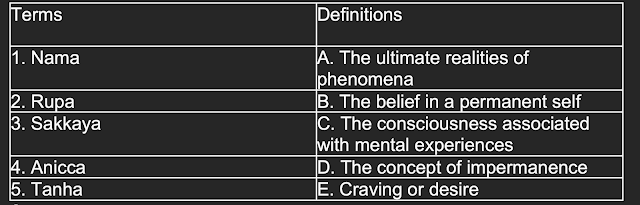
Answers:
1 - C, 2 - A, 3 - B, 4 - D, 5 – E
Scenario-Based Questions
1. A student is practicing meditation and becomes distracted by the sound of traffic outside. Based on the concepts learned, how should the student approach this distraction?
Response:
The student should observe the sound as an outer guest and recognize it as just sound, not allowing it to disrupt their focus. They can return to the awareness of their breath, understanding that the sound is a temporary experience and does not affect their inner state of calm.
2. During a meditation session, a practitioner feels a strong urge to check their phone. How can they apply the teachings of inner guests to this situation?
Response:
The practitioner should recognize the urge as an inner guest, specifically the craving for connectivity. By acknowledging this craving without judgment and returning to the breath, they can observe how such desires arise and pass away, reinforcing their understanding of non-attachment.
3. A person feels anger when someone cuts them off in traffic. How can they use mindfulness to deal with this emotion?
Response:
The individual should practice mindfulness by recognizing the anger as an arising inner guest. They can reflect on whether this anger is a true representation of 'self' or merely an emotional reaction. By observing the anger without attaching to it, they can realize its impermanence and choose a more constructive response.
Critical Thinking Questions
1. Analyze how the concept of 'self' is challenged by the teachings of samadhi. In what ways can this understanding influence one’s behavior in daily life?
Response:
The concept of 'self' is challenged by the understanding that cravings and emotions like anger are not inherent to one's identity but are transient experiences. This realization can lead to a more compassionate and patient approach to interactions with others, reducing conflicts and enhancing emotional regulation. By recognizing that the 'I' is a construct, one can cultivate a sense of freedom from attachment to negative emotions.
2. Discuss the differences between nama and rupa in the context of sensory experiences. How does this distinction contribute to deeper mindfulness practices?
Response:
Nama refers to the mind's consciousness associated with sensory experiences, while rupa represents the physical aspects of these experiences. Understanding this distinction allows practitioners to separate their perceptions from the objects they perceive. This clarity aids in developing mindfulness, as one can learn to observe their thoughts and feelings without becoming entangled in them, leading to greater insight and tranquility during meditation.
3. Reflect on the importance of observing both inner and outer guests during meditation. How does this practice deepen one's understanding of impermanence?
Response:
Observing both inner and outer guests allows practitioners to recognize the transient nature of thoughts, emotions, and sensory inputs. By acknowledging that both the distractions and the awareness of breath are temporary, one can cultivate a profound understanding of impermanence. This awareness can lead to reduced attachment and suffering, as practitioners learn to see all experiences as fleeting moments rather than permanent fixtures of their reality. 


Analyzing the Inner and Outer Guests in the Practice of Samadhi
Abstract
This study investigates the teachings of Mogok Sayadaw regarding the concepts of six inner guests and five outer guests in the context of achieving samadhi (meditative absorption). By analyzing the relationships between these guests and the resulting states of awareness, this research aims to deepen understanding of the mind's interactions during meditation. We utilize a data set from various meditation trials to evaluate the presence and impact of these guests on practitioners' experiences.
Hypothesis
The presence of inner and outer guests significantly affects the practitioner's ability to maintain awareness of the breath, influencing the overall experience of samadhi.
Data Set
The following table presents the results of meditation trials conducted over ten sessions, measuring the frequency of awareness of the inner guests, outer guests, and the host (awareness of breath).
Conclusion
The study's findings suggest a clear relationship between the guests and host awareness. Higher frequencies of inner and outer guests corresponded to lower levels of host awareness, indicating that distractions can diminish the ability to focus on the breath. Conversely, a greater awareness of the breath was noted when inner guests were absent, supporting the hypothesis that clarity of meditation improves when distractions are minimized.
Data Analysis Questions
1. What trend can be observed between the frequency of inner guests and host awareness across the trials?
2. How does the presence of outer guests correlate with the levels of host awareness in the meditation sessions?
3. In which trial was the highest level of host awareness recorded, and what was the corresponding frequency of inner and outer guests?
Study Evaluation Questions
1. What limitations might be present in the methodology used for data collection in this study?
2. How could potential biases in participant responses affect the validity of the results?
3. In what ways could the study design be improved to provide more reliable and comprehensive insights into the meditation practices?

Exam: Understanding Samadhi, Inner and Outer Guests
Subject: Buddhist Philosophy
Total Questions: 35
Time Limit: 90 minutes
Instructions: Answer all questions to the best of your ability. Read each question carefully and follow the instructions provided.
Learning Objectives
Understand the concepts of inner and outer guests as taught by the Mogok Sayadaw.
Analyze the relationship between craving, desire, and the notion of self.
Apply concepts of awareness and mindfulness in real-world scenarios.
Synthesize knowledge of Buddhist teachings on impermanence and non-self

Question Types
Multiple Choice (10 Questions)
1. What does the term 'host' refer to in the context of samadhi?
A) The inner guests
B) The act of breathing
C) The practice of meditation
D) The outer guests
2. Which of the following is NOT considered one of the five outer guests?
A) Seeing
B) Hearing
C) Thinking
D) Smelling
3. When an outer guest arrives, such as a sound, what are the two elements involved according to the teachings?
A) Nama and rupa
B) Self and craving
C) Inner and outer guests
D) Desire and anger
4. The term 'sakkaya-ditthi' refers to:
A) The belief in self
B) The act of observing breath
C) The understanding of impermanence
D) The cessation of suffering
5. Which of the following best describes craving in Buddhism?
A) A natural human emotion
B) A fundamental source of suffering
C) An illusion created by the mind
D) A necessary aspect of life
6. When no inner or outer guests are present, what should one focus on?
A) The surrounding environment
B) The in-and-out breath
C) The thoughts in the mind
D) The presence of others

7. Which of the following concepts is associated with the absence of desire?
A) Suffering
B) Nirvana
C) Attachment
D) Craving
8. According to the teachings, what happens to conditioned things?
A) They become permanent.
B) They are always satisfying.
C) They are impermanent.
D) They can be controlled.

9. When analyzing anger, what does the teaching suggest?
A) It is a form of self-expression.
B) It is always justified.
C) It is a manifestation of sakkaya.
D) It can be ignored.
10. The practice of observing the 'host' is meant to:
A) Enhance self-awareness.
B) Increase external distractions.
C) Diminish the value of meditation.
D) Promote constant thinking.
True/False (5 Questions)
11. The six inner guests are greed, hatred, delusion, non-greed, non-hatred, and thinking mind.
True
False
12. When experiencing desire, the concept of 'self' is always present.
True
False
13. The teachings suggest that anger is not worth studying.
True
False
14. Observing the in-and-out breath is essential when there are no distractions.
True
False

15. Nama and rupa are seen as ultimate realities in Buddhist philosophy.
True
False
Fill-in-the-Blank (5 Questions)
16. The five outer guests include consciousness of __, hearing, smelling, tasting, and touching.
17. When craving arises, it is often linked to __ khandha.
18. The __ of seeing a car versus just the sound is an important distinction in understanding reality.
19. Anger is classified under the concept of __ in Buddhist teachings.
20. Observing the __ is crucial when no external or internal distractions are present.
Matching (5 Questions)
Match the term to its correct definition:
21. Nama
22. Rupa
23. Sakkaya-ditthi
24. Anicca
25. Tanha
A) The belief in self
B) The concept of impermanence
C) Craving or desire
D) The mind or consciousness
E) Physical matter or form
Short Answer (5 Questions)
26. Explain the significance of recognizing the difference between desire and the notion of 'self'.
27. How does the concept of craving relate to the teachings of the Mogok Sayadaw?

28. Discuss the implications of observing inner and outer guests in daily life.
29. What is the role of mindfulness in the context of the six inner guests?
30. How can understanding impermanence lead to a reduction in suffering?

Essay (5 Questions)
31. Reflect on how the teachings of the Mogok Sayadaw can be applied to modern-day situations involving stress and anger. Provide specific examples.
32. Analyze the connection between craving and the concept of sakkaya-ditthi. How can understanding this relationship lead to personal growth?
33. Discuss the importance of the 'host' in meditation practice and how it can help in recognizing distractions.
34. How can observing the absence of thoughts and feelings contribute to one's understanding of impermanence?
35. In what ways can the teachings of awareness and mindfulness influence interpersonal relationships in contemporary society?
Evaluation Criteria
Multiple Choice, True/False, Fill-in-the-Blank: Each correct answer is worth 1 point.
Matching: Each correct match is worth 1 point.
Short Answer: Each response will be graded on clarity, relevance, and depth of understanding (5 points each).
Essay: Responses will be evaluated based on argument structure, integration of teachings, and real-world application (15 points each).

Total possible score: 100 points.
Good luck!


The Four Layers Self Assessments!


The Four Layers of Dependent Origination

 Multiple-Choice Questions

1. What does the Past Cause Layer primarily consist of?
   - A) Viññāṇa and Nāma-rūpa  
   - B) Avijjā and Saṅkhāra  
   - C) Taṇhā and Upādāna  
   - D) Jāti and Jarā-maraṇa  

2. Which dhamma is NOT part of the Present Effect Layer?
   - A) Phassa  
   - B) Vedanā  
   - C) Upādāna  
   - D) Nāma-rūpa  

3. What is the primary focus of the Present Cause Layer?
   - A) Jāti  
   - B) Avijjā  
   - C) Kamma-bhava  
   - D) Viññāṇa  

4. Which Noble Truth corresponds to the Future Effect Layer?
   - A) Dukkha-sacca  
   - B) Samudaya-sacca  
   - C) Nirodha-sacca  
   - D) Magga-sacca  

5. What is the correct relationship between the Present Effect Layer and a Noble Truth?
   - A) It is Nirodha-sacca  
   - B) It is Samudaya-sacca  
   - C) It is Dukkha-sacca  
   - D) It is Magga-sacca  

Vocabulary Matching

Match the terms on the left with their correct definitions on the right.
| Term          | Definition                                   |
|---------------|----------------------------------------------|
| A) Avijjā    | 1) The process of becoming or existence.    |
| B) Taṇhā     | 2) The feeling or experience of sensation.   |
| C) Jāti      | 3) Ignorance, a lack of understanding.      |
| D) Saṅkhāra  | 4) Birth or coming into existence.          |
| E) Upādāna   | 5) Craving or desire for objects or experiences. |

Scenario-Based Questions

1. A student is struggling with procrastination and wants to change their study habits. Based on what you've learned about the Four Layers of Dependent Origination, what two strategies could they apply to improve their focus and productivity?
   _______________________________________________________________________
   _______________________________________________________________________
   _______________________________________________________________________
2. A community is facing increasing rates of mental health issues. Considering the Present Cause Layer, how might addressing Taṇhā and Upādāna help in alleviating this situation?
   _______________________________________________________________________
   _______________________________________________________________________
   _______________________________________________________________________
3. A new parent is worried about the future well-being of their child. Reflecting on the Future Effect Layer, what two actions could they take to ensure a positive upbringing?
   _______________________________________________________________________
   _______________________________________________________________________
   _______________________________________________________________________
Critical Thinking Questions
1. Analyze how the concept of Avijjā (ignorance) in the Past Cause Layer can lead to unhappiness. In your opinion, how might educating individuals about this concept reduce suffering in society?
   _______________________________________________________________________
   _______________________________________________________________________
   _______________________________________________________________________
   _______________________________________________________________________
   _______________________________________________________________________
2. Compare the Present Effect Layer with the Future Effect Layer. How does understanding the relationship between these layers enhance our comprehension of the cycle of suffering and rebirth?
   _______________________________________________________________________
   _______________________________________________________________________
   _______________________________________________________________________
   _______________________________________________________________________
   _______________________________________________________________________
3. Discuss the significance of the Samudaya-sacca and Dukkha-sacca in understanding the Four Layers. How can recognizing these truths empower individuals to make meaningful changes in their lives?
   _______________________________________________________________________
   _______________________________________________________________________
   _______________________________________________________________________
   _______________________________________________________________________
   _______________________________________________________________________
---