Dhamma · Reflection · Statements · Peaceful Communication

Office Of Siridantamahapalaka

Chronological Archive

Report on Recent Activities in Sri Lanka

Date: March 16, 2024

1. Hswagata Museum Founder Meets Chief Custodian of Sacred Tooth Relic Temple

The founder of the Hswagata Museum, renowned for its preservation of Buddhist artifacts, had an esteemed meeting with the Chief Custodian of the Sacred Tooth Relic Temple in Sri Lanka. Discussions centered around mutual cooperation in preserving and promoting Buddhist heritage.


2. Indasoma Bhikkhu Explores Buddha's Teachings with Sri Lankan University Students and Psychologists

Indasoma Bhikkhu, a distinguished Buddhist monk, engaged Sri Lankan university students and psychologists in an enlightening discourse on Buddha's teachings regarding Citta (mind) and sensory perception. This exchange aimed to bridge ancient wisdom with contemporary understanding.


3. Foundational Teacher Training Integrating Buddha's Teaching Methodology

A pioneering teacher training program is set to commence in Sri Lanka, integrating Buddha's teaching methodology into modern educational practices. This initiative seeks to cultivate holistic and compassionate learning environments inspired by Buddhist principles.

4. Renowned Myanmar Monk Sao Dhammasami Honored with Lifetime Special Membership

The Khettarama Social Service Foundation bestowed lifetime special membership upon Sao Dhammasami, a revered monk from Myanmar, recognizing his significant contributions to Buddhism and social welfare.

5. MOU between Hswagata (Myanmar) and Nirvana Temple (Congo)

A memorandum of understanding (MOU) was established between the Hswagata Museum in Myanmar and the Nirvana Temple in Congo, fostering cultural exchange and cooperation in Buddhist heritage preservation.

6. Khettarama Social Service Foundation Donates Land for Buddha Education Temple

In a generous gesture, the Khettarama Social Service Foundation donated land for the construction of a Buddha Education Temple in Sri Lanka, aiming to facilitate spiritual learning and community engagement.

7. Sri Lankan Monk Venerable Kowane Palitha Thero Named Patron

Venerable Kowane Palitha Thero, esteemed for his dedication to Buddhism, was appointed as the patron of the Hswagata Buddha Tooth Relics Preservation Museum, acknowledging his commitment to heritage conservation.

8. Khettarama Social Service Foundation and Hswagata Museum, Myanmar Make MOU

An MOU was formalized between the Khettarama Social Service Foundation and the Hswagata Museum in Myanmar, signifying a commitment to collaborative efforts in promoting Buddhist culture and welfare initiatives.

9. Honorary Senior Advisor and Lifetime Membership Presented

Dr. Pradeep was honored by the founder of the Hswagata Museum with a Certificate of Honorary Senior Advisor and Lifetime Membership, recognizing Dr. Pradeep's invaluable support and contributions to the museum's endeavors.

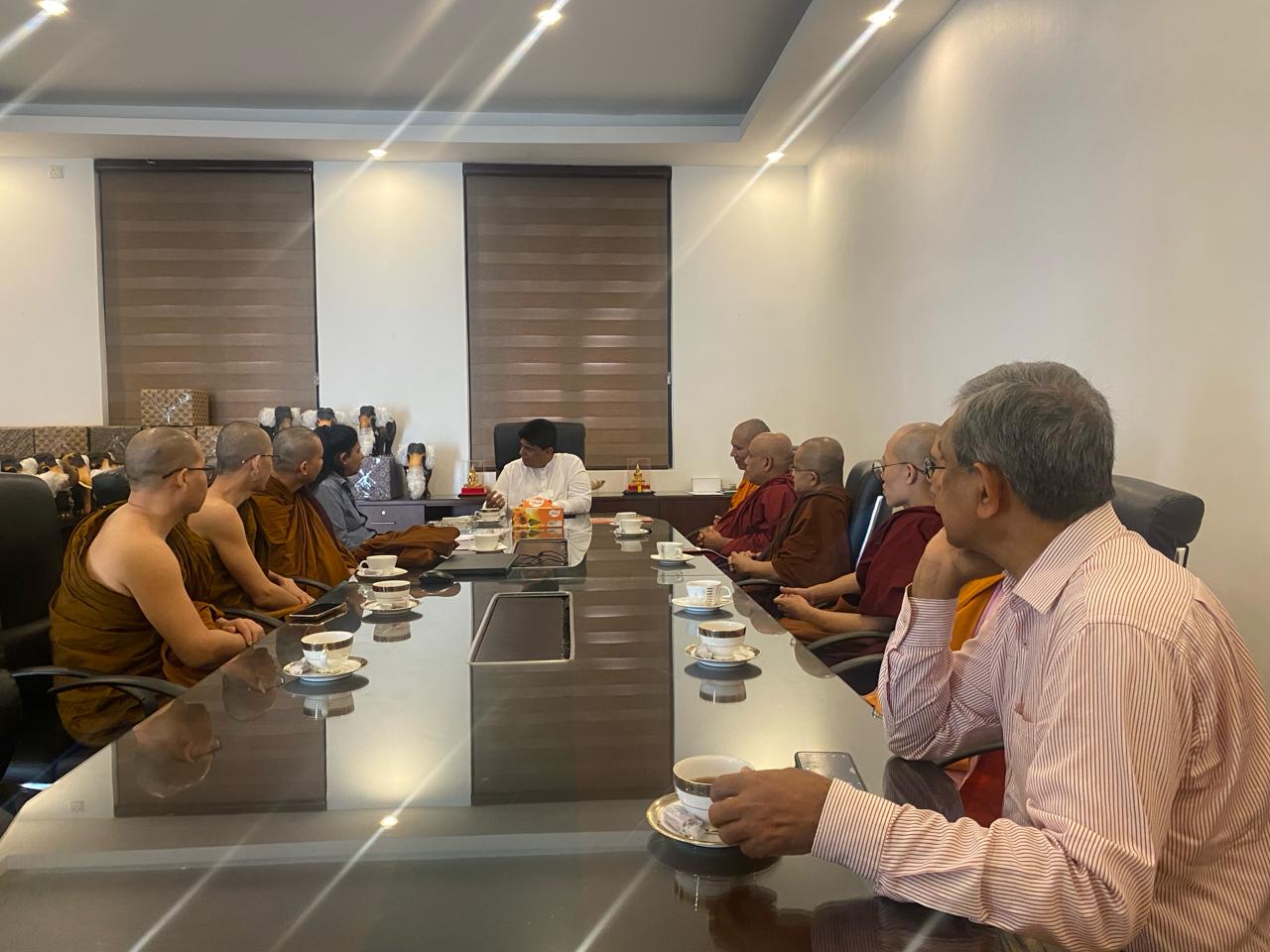
These activities reflect a vibrant exchange of knowledge, culture, and goodwill, further enriching Sri Lanka's spiritual landscape and global Buddhist community. 


A Masterpiece of Gandharan Art: The Buddha Image Donated by Monk Buddhananda

Discovery by Charles Masson (1827 CE / 2370 BE)

During his explorations of ancient Gandhara (modern-day Jalalabad, Afghanistan and northern Pakistan), British explorer Charles Masson uncovered numerous artifacts including coins, inscriptions, seals, and Buddhist sculptures at a ruined monastery. Among these treasures was an exceptionally crafted Gandharan-style Buddha statue:


  • Material: Black stone

  • Style: Greco-Buddhist (Hellenistic influence)

  • Posture: Seated in teaching posture (dharmachakra mudra)

  • Base: Four-tiered lotus pedestal flanked by two standing Bodhisattvas

  • Date: ~357 CE (900 BE) - Peak of Buddhist art in Gandhara


The Inscription (Kharoṣṭhī Script)

The base bears a bilingual Prakrit-Sanskrit inscription:

*"Saṃ 4 1 Phaguṇasa māsasa di pañcamī Buddhanandasa Trepiṭakasa dānamukhe mātā-pitṛ-dhara-vadina puṇyāye bhavatu"*

Translation:
"In the year 5, on the 5th day of the month of Phālguna (February–March), this religious gift was made by the Venerable Buddhananda, Master of the Tripiṭaka. May this merit extend to his departed parents."

Significance of the Donor

  • Monk Buddhananda: The title "Trepiṭaka" (Pali: Tipiṭaka) confirms he was a highly learned scholar who had memorized the Buddhist canon.

  • Filial Piety: The dedication to his deceased parents reflects the Buddhist practice of matapitṛ-pūjā (honoring ancestors through merit-making).

Current Location

The statue is displayed at the Metropolitan Museum of Art, New York (Gallery 235).


Why This Artifact Matters

  1. Cross-Cultural Artistry:

    • Combines Greek realism (wavy hair, draped robe) with Indian Buddhist iconography.

    • The lotus base symbolizes purity in both Hindu and Buddhist traditions.

  2. Historical Context:

    • Created during the Kushan Empire when Gandhara was a Buddhist hub.

    • Shows monastic patronage of art for spiritual and memorial purposes.

  3. Colonial Legacy:

    • Like many Gandharan artifacts, it was removed during British colonial rule.

Did You Know? The month Phālguna corresponds to modern February–March, when Buddhist festivals like Māgha Pūjā occur.

(Note: "Trepiṭaka" was an honorific for monks who mastered the Vinaya, Sutta, and Abhidhamma texts.)

The Inscribed Vase from Taxila: A Sacred Relic of Ancient Buddhist Glory

The Inscribed Vase from Taxila: A Sacred Relic of Ancient Buddhist Glory


Taxila: The Legendary Seat of Learning

Taxila (तक्षशिला), known as Takkasilā in Pali and Taxila in modern usage, was one of the ancient world's greatest centers of education. Located near present-day Rawalpindi, Pakistan, this UNESCO World Heritage Site (inscribed in 1980) attracted legendary figures:

  1. King Pasenadi of Kosala – The Buddha’s royal disciple.

  2. Aṅgulimāla – The notorious bandit-turned-monk.

  3. Mahāli the Licchavi – A nobleman who debated the Buddha.

  4. General Bandhula – A military strategist.

  5. Jīvaka Komārabhacca – The Buddha’s personal physician.


Historical Accounts of Taxila

  • 5th century CE (943 BE): Chinese pilgrim Faxian described Taxila as the place where the Bodhisattva sacrificed his head (hence the name "Cut-Head City") and later gave his body to a starving tigress.

  • 630 CE (1173 BE): Xuanzang recorded King Ashoka’s stupas here, including one marking Prince Kunāla’s tragic blinding and another honoring the Bodhisattva’s 100 self-beheadings as King Candraprabha.


The Inscribed Vase: A Buddhist Treasure

  • Discovery: Excavated by Sir John Marshall (1902–1931), former Director-General of Archaeology in India.

  • Description: A 12-cm-wide clay jar, inscribed in Kharoṣṭhī script (Prakrit language).

  • Inscription:

    "Sihilena Sīhalajitena ca bhrātarehi Takṣaśilāye ayaṃ thūvo (thūpo) pratiṣṭhāvito savabudhānaṃ pūjāye"
    Translation:
    "This water stupa was established at Takshashila by the brothers Sīhala and Sīharakṣita in worship of all Buddhas."

Key Insights:

  1. Donors: The brothers Sīhala (possibly from Sri Lanka) and Sīharakṣita ("Lion-Protected").

  2. Ritual Use: The jar likely held water for stupa consecration (thūpo = stupa).

  3. Historical Proof: Confirms Taxila’s name in ancient Prakrit (Takṣaśilā) and its role as a Buddhist pilgrimage site.


Where to See It Today

The vase is displayed at the Chandigarh Museum, India—a testament to Taxila’s multicultural Buddhist heritage, where Greek, Persian, and Indian influences merged under the Kushan Empire.


Why This Matters

  • Global Legacy: Taxila’s artifacts are scattered worldwide (e.g., British Museum, Lahore Museum), highlighting colonial-era archaeology.

  • Buddhist Philanthropy: The inscription reflects lay devotion through stupa-building, a practice Ashoka popularized.

Fun Fact: The "water stupa" (thūvo) may symbolize the Bodhisattva’s compassion—flowing like water to nourish all beings.

(Note: "Sīhala" might link to Sri Lanka, suggesting ancient maritime Buddhist networks.)


Harmony Unveiled: The Sacred Relics and the Journey of Reconciliation

There Was More Than One Buddhaghosa: A Remarkable Archaeological Discovery

The Discovery by Dr. Vogel: An Archaeologist's Struggle

In 1901 (2444 BE), Dr. Jean Philippe Vogel, a Dutch scholar specializing in Sanskrit and Indian paleography, was appointed as the Superintendent of the Western Circle of the Archaeological Survey of India (covering Pakistan and northern India). He began his work with extremely limited resources—only three Indian assistants and one cook! With no proper office, he had to rent workspace in Lahore before eventually moving to Taxila.


The Groundbreaking Excavation

In 1905 (2448 BE), Vogel's team excavated the Loriyan Tangai site in Swat Valley, unearthing numerous Gandhara Buddhist sculptures. Among them was a particularly significant find:

  • Artifact: The base of a standing Buddha statue in the varada mudra (gesture of granting blessings) posture. The upper portion was missing, leaving only the inscribed base.

  • Origin: Buddhist monastery at Loriyan Tangai, Swat Valley, Pakistan.

  • Inscription: A single line in Kharoṣṭhī script, using mixed Prakrit-Sanskrit:

    "Saṃvatsare 318 20 4 1 1 1 Buddhaghosasa danamukhe Saghorumasa sadaviyarisa"
    Translation:
    "In the year 318, on the 27th day of the month of Bhādrapada (August–September), this donation was made by the teacher Buddhaghosa, together with his companion, the teacher Sanghavarman."


Why This Discovery Matters

  1. Challenges Historical Assumptions:

    • The famous Buddhaghosa of Theravada tradition (author of the Visuddhimagga and Pali commentaries) lived around 457 CE (1000 BE).

    • This inscription proves the existence of another Buddhaghosa—a Gandharan monk active in ~200 CE (700 BE), 300 years earlier!

  2. Evidence of Gandharan Buddhism:

    • Shows the vibrant monastic culture of ancient Swat Valley.

    • Confirms that "Buddhaghosa" (meaning "Voice of the Buddha") was likely an honorific title used by multiple scholars.

  3. Current Location:
    The artifact is displayed at the British Museum, London.


Key Takeaways

  • Not a Single Figure: The name "Buddhaghosa" belonged to at least two distinct historical figures.

  • Gandhara's Legacy: The inscription highlights Swat Valley's role as a center of Buddhist learning long before the "Theravada Buddhaghosa."

  • Colonial Archaeology: Many such finds were transported to Western museums during the British era.

Fun Fact: The date "Year 318" likely refers to the Kanishka era (starting 127 CE), placing this Buddhaghosa in the 2nd–3rd century CE.

(Note: The inscription's "Sanghavarman" may be linked to the monk who later translated texts into Chinese.)

Buddhist Heritage of Uzbekistan


Introduction

Today, we explore one of the most significant Buddhist sites in Uzbekistan—Fayaz Tepe. Located along the Silk Road, Uzbekistan’s capital is Tashkent. Originally, the people followed Zoroastrianism (fire worship), but later, Buddhism gained limited influence in the region.


Historical Accounts: Xuanzang’s Journey (630 CE / 1173 BE)

When the Chinese monk Xuanzang (Tang Sanzang) passed through Samarkand, he recorded:
"The king and people did not initially believe in the Buddha’s teachings, adhering instead to fire worship (Zoroastrianism). There were two monasteries in the city, but no resident monks. If foreign monks tried to stay, locals would light fires to drive them away. When I arrived, the king received me reluctantly, but after hearing the Dharma, he converted and took precepts. Two novice monks accompanying me visited the monasteries but were chased away with fire. The enraged king wanted to cut off the attackers’ hands, but I intervened, and they were merely exiled. Later, I organized a Dharma assembly, and many people embraced Buddhism."
(Keng Lian Sibunruang, The Biography of Xuanzang, p. 88)

Key Takeaway:

  • Buddhism struggled against Zoroastrian dominance until Xuanzang’s mission.

  • By 1057 CE (1600 BE), Muslim conquests erased most Buddhist presence.


Archaeological Rediscovery

In 1960 CE (2503 BE), Russian archaeologist V.A. Kuznetsov excavated Fayaz Tepe, uncovering:

  • Buddhist monastery with Gandharan-style artifacts, including a seated Buddha preaching.

  • Now displayed at the National Museum of Tashkent.


Recent Research:
Thai scholar Prof. Dr. Banjob Bannaruji and team visited Uzbekistan, confirming ~20 Buddhist sites, with four major ones excavated:

  1. Fayaz Tepe

  2. Kara Tepe

  3. Ayrtam

  4. Zurmala


Modern Context

  • Population: 30 million (94% Muslim).

  • Capital: Tashkent.

  • Legacy: Uzbekistan’s Buddhist ruins reflect its Silk Road role as a crossroads of faiths.


Significance:

  • Proof of Buddhism’s fleeting but profound impact in Central Asia.

  • Artifacts show Gandharan influence, linking Uzbekistan to Afghanistan/Pakistan’s Buddhist art.


Why This Matters

  • Cultural Exchange: Uzbekistan’s Buddhist past highlights Silk Road diversity.

  • Preservation Challenge: Many sites remain unexcavated, risking loss to time.

(Note: "Fayaz Tepe" is sometimes spelled "Fayoz-Tepe" or "Fayaztepa.")


Sacred Request: Preserving the Legacy of the Buddha's Tooth Relics

In the serene early hours of January 2022, the Hswagata Buddha Tooth Relics Preservation Museum in Yangon was enveloped in a profound sense of reverence. Amongst the whispering prayer flags and the hushed tones of devotees, a significant meeting was convened. Present were esteemed figures, each bearing a weight of responsibility and devotion to the preservation of sacred relics.


Mr. Aung Bhone Pyae, known also as Pyae Toe Aung, graced the gathering as the Senior First Secretary, radiating an aura of solemnity and purpose. Alongside him stood Mr. Thura Kyaw, affectionately referred to as Myo Min Khine, who held the esteemed position of Management Team Member, his presence commanding respect and attention. Completing this trio of esteemed individuals was Mr. Htin Kyaw Hlaing, a Senior Member of the Central Committee, his dedication to the cause evident in every gesture.


Their purpose was clear, their hearts aligned in a singular quest: to propose to Sao Dhammasami, the guardian of the relics, a request of utmost significance. With a deep reverence, they approached Sao Dhammasami, seeking permission to create copies of the precious Buddha Tooth Relics. Their intention was noble yet simple - to allow devotees the opportunity to worship and receive the blessings of these revered artifacts.


As the anticipation in the air thickened, Sao Dhammasami, embodying wisdom and grace, bestowed upon them the honor of opening the discourse. With a voice that resonated with centuries of tradition and spirituality, Sao Dhammasami spoke, affirming the sanctity of their endeavor. He acknowledged the profound significance of the relics and the responsibility that came with their preservation. Yet, he also recognized the importance of spreading the blessings far and wide, allowing the faithful to partake in their reverence.

With Sao Dhammasami's blessing, the program to create copies of the Buddha Tooth Relics was set into motion. It was a momentous occasion, marked by a union of faith, tradition, and the unwavering commitment to honor the legacy of the Buddha. As the first light of dawn gently kissed the temple's facade, a new chapter in the journey of devotion began, carrying forth the blessings of the relics to all who sought solace and enlightenment.


Devotion at Hswagata Yangon: Worshiping the Tooth of the Lord Buddha

In January 2022, at the sacred Hswagata Yangon temple in Myanmar, devout followers gathered to pay homage to the revered tooth relics of the Lord Buddha. The air was filled with a sense of reverence and devotion as worshippers arrived, carrying offerings of food, flowers, and water as symbols of their respect and gratitude.


The temple grounds buzzed with activity as devotees meticulously arranged their offerings before the sacred shrine, ensuring each item was presented with the utmost care and sincerity. Bowls of steaming rice, fragrant incense sticks, vibrant garlands of flowers, and pitchers of clean water adorned the altar, creating a picturesque scene of devotion and piety.

As the soft glow of candlelight flickered in the dimly lit temple, worshippers bowed their heads in silent prayer, their hearts filled with reverence for the divine presence of the Lord Buddha. The sound of murmured chants and gentle hymns filled the air, echoing through the sacred halls and resonating with the collective spirit of the faithful.

With each heartfelt offering and fervent prayer, the devotees expressed their deep reverence and unwavering faith in the teachings of the Buddha. Their acts of devotion served as a testament to their profound connection to the spiritual realm and their commitment to walking the path of enlightenment.

In the tranquil sanctuary of Hswagata Yangon temple, amidst the serenity of the sacred space, worshippers found solace and inspiration in the timeless wisdom of the Buddha. It was a moment of profound significance, a sacred communion between the earthly and the divine, as devotees humbly bowed before the tooth of the Lord, seeking blessings and guidance on their journey towards enlightenment.


Three Alexanders in Indian History: From Conquerors to Archaeologists


1. Alexander the Great (327 BCE / 110 BE)

  • The Invader: The Macedonian king who crossed into India in 327 BCE, defeating King Porus (Paurava) at the Battle of the Hydaspes (Jhelum River).

  • Legacy: Though his campaign ended at the Beas River due to mutiny, he left Greek settlements that influenced Gandharan art and culture.


2. Alexander of Epirus (Referenced in Ashoka’s Edicts, 268–232 BCE / 218 BE)

  • The Distant King: Ashoka’s 13th Rock Edict at Shahbazgarhi (Swat Valley, Pakistan) lists six Hellenistic rulers, including:

    1. Antiyoka = Antiochus II of Syria (Seleucid Empire)

    2. Turumaya = Ptolemy II of Egypt

    3. Antekina = Antigonus II of Macedon

    4. Maka = Magas of Cyrene (Libya)

    5. Alikasundara = Alexander II of Epirus (a lesser-known cousin of Pyrrhus)

  • Diplomacy: Ashoka sent Buddhist emissaries to these kingdoms, marking the first Indo-Mediterranean cultural exchange.

3. Alexander Cunningham (1833 CE / 2376 BE)

  • The Archaeologist: A British officer turned "Father of Indian Archaeology," he:

    • Mapped Buddhist sites using Xuanzang’s travel records.

    • Founded the Archaeological Survey of India (ASI) in 1861.

    • Excavated Sanchi, Sarnath, and Taxila, saving them from oblivion.


Why These Three Matter

  1. Military Conquest → Cultural Fusion: Alexander’s invasion paved the way for Greco-Buddhist art.

  2. Ashoka’s Outreach: His edicts prove ancient India’s awareness of the Hellenistic world.

  3. Colonial Rediscovery: Cunningham’s work preserved India’s Buddhist heritage—though artifacts like the Kandahar Greek Edict remain in Afghanistan.

Fun Fact: The name "Alexander" (Greek: Alexandros, "Defender of Men") was so revered that Ashoka’s scribes used it for multiple kings!

(Note: Alexander II of Epirus ruled a minor kingdom but was included as part of Ashoka’s diplomatic "name-dropping.")